Climate: 2025 was the third hottest year in history
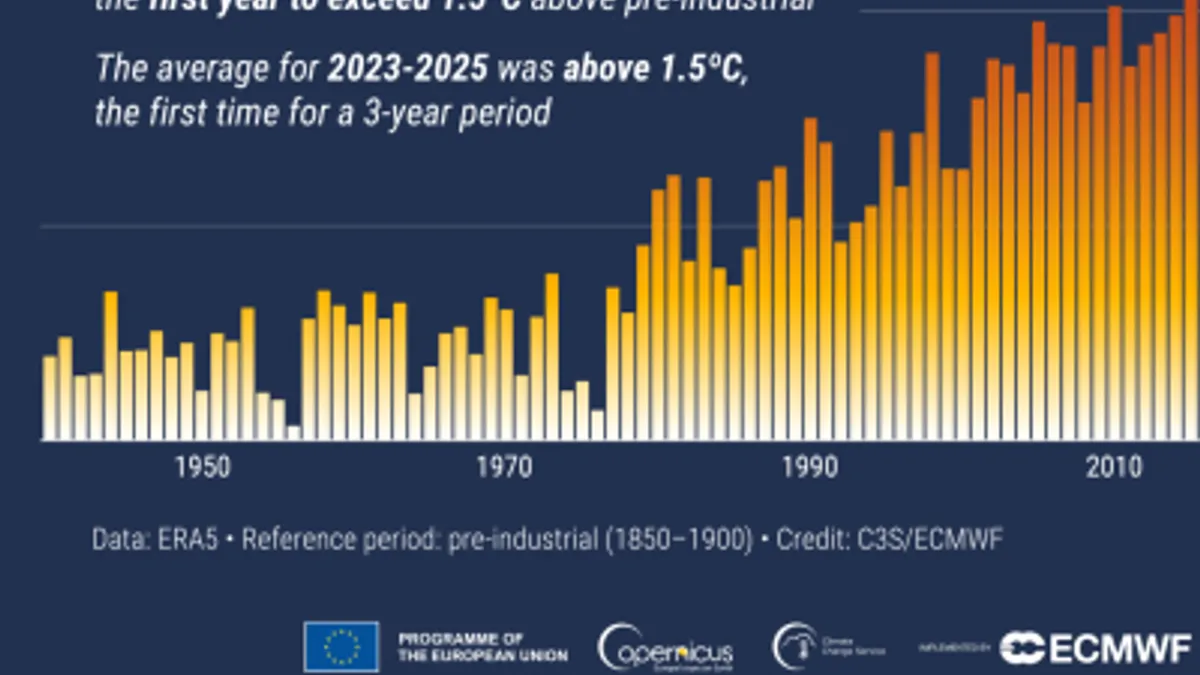 Imagen: Copernicus
2025 was the third hottest year on record, barely 0.01 °C cooler than 2023 and 0.13 °C cooler than 2024, the hottest year ever measured. Data from the European climate service Copernicus confirm that the 2023-2025 period exceeded for the first time the historical average of 1.5 °C above pre-industrial levels, the most ambitious goal of the Paris Agreement.
The temperature in numbers
According to the ERA5 dataset, the global mean surface temperature in 2025 was 1.47 °C above pre-industrial levels (1850-1900 average), after the 1.60 °C of 2024. The last 11 years have been the 11 warmest on record. Antarctica recorded its highest annual temperature in history, and the Arctic the second highest.
Why it keeps rising
The three exceptionally warm years have two main causes: the accumulation of greenhouse gases, due to continuous emissions and lower CO₂ absorption by natural sinks, and exceptionally high ocean temperatures, associated with an El Niño event. In 2025, half of the planet’s land surface experienced more days than usual with strong heat stress, defined as a heat index of 32 °C or more.
Extreme events around the world
The year was marked by record heat waves, severe storms in Europe, Asia and North America, and wildfires in Spain, Canada and Southern California. Heat stress is recognized by the World Health Organization as the leading cause of climate-related deaths worldwide.
The practical takeaway
The figure matters beyond the charts: the Caribbean region is among the most exposed to hurricanes and heat waves, and each additional tenth of a degree increases the risk. The warmest three-year period in history is not a passing anomaly but the new normal to plan for: from electrical infrastructure to preparation for more intense storms.